Iris Nevus
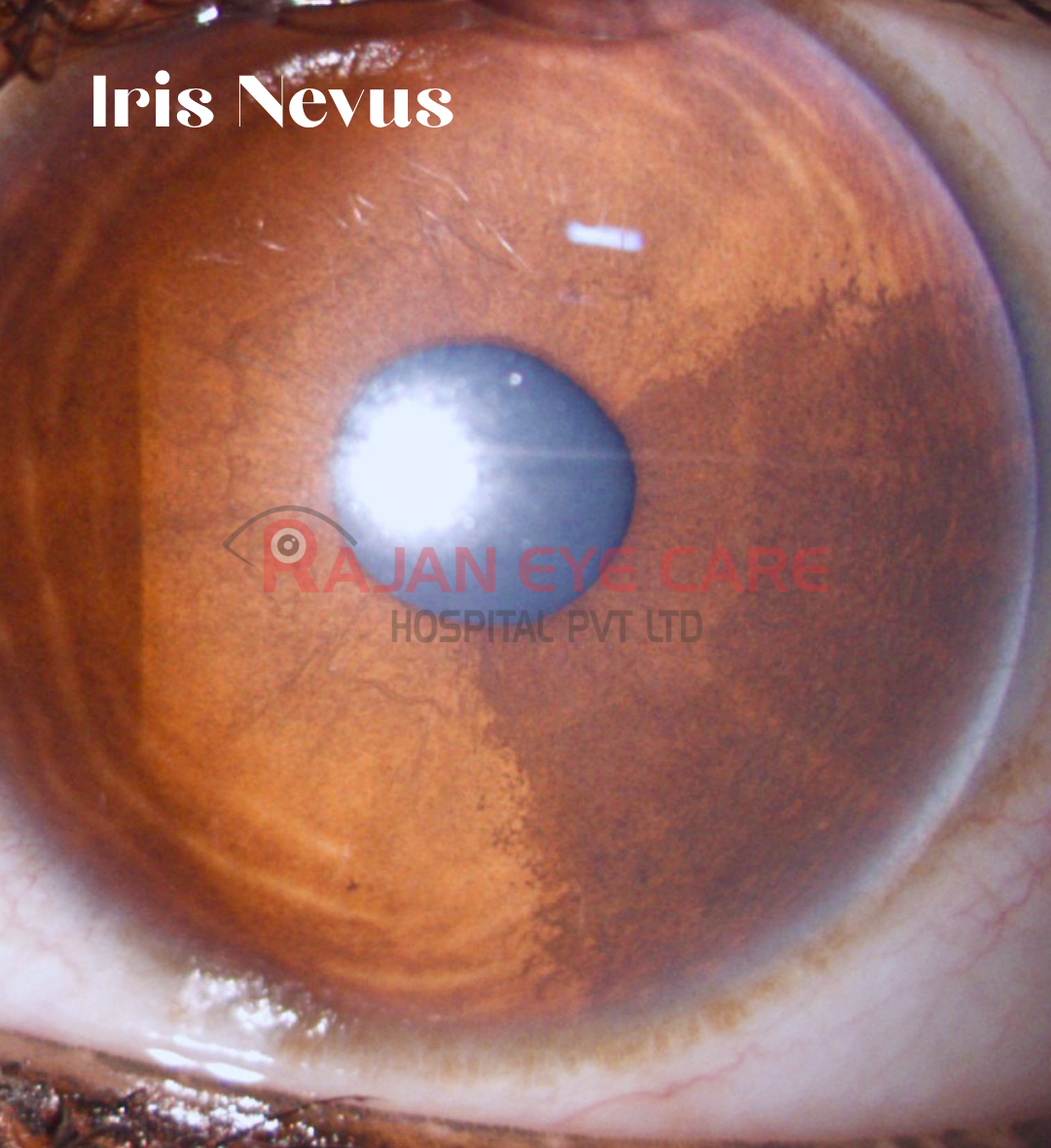
•Generally benign, dark brown, or pigmented spot (or "freckle") on the iris, caused by melanocyte growth
•Can be a pigmented or nonpigmented spot, typically about 3 mm in diameter and with an inferior clock-hour position
•They penetrate the iris stroma, often distorting its architecture, and may be associated with corectopia or iris ectropion
•Appearance: They are usually dark brown, though they can be light-colored or nonpigmented, and can be flat or slightly raised
•Location: They often appear in the lower half of the iris (inferior clock-hour position)
•Risks: While most are benign, there is a small risk of conversion to iris melanoma, about 5% at 5 years and 8% at 15 years
•DIAGNOSIS: Monitor size, shape with slit-lamp photography
•How do we predict if iris nevus can transform into iris melanoma?
ABCDEF risk factors
A: Age at presentation <40 years
B: Blood - Spontaneous hyphema
C: Clock hour location - inferior quadrant
D: Diffuse involvement of the entire iris
E: Ectropion uveae
F: Feathery edges
•MANAGEMENT: Observation and monitoring
Image from Rajan Eye Care Hospital
#ophthalmology #ophthal #doctor #health #medical #vision #education #optometry #medicalstudent #optometrist #medicine #eye #ophtho #ophthalmologist #ophthalmo #med #medicaleducation #ophthalmologyresident #ophthalmologyresidency #apaoyo #iris #irisnevus #irismelanoma
